

Mount Willard is a 3.1-mile out-and-back in Crawford Notch that gets you a summit view most people would drive hours for, in about 90 minutes round trip. I rated it a 5.5/10 overall, but the view is a 10, but the trail itself won’t be pulling me back for repeat training runs, especially with all of the excellent trails in White Mountain National Forest.
Mount Willard Trail at a Glance
- Route type
- Out-and-back
- Start → finish
- Crawford Depot → Mount Willard viewpoint → Crawford Depot
- Highest point
- Mount Willard · 2,864 ft
- Terrain
- Large rocks, exposed roots and sustained climbing
- Exposure
- Forested trail with an exposed summit ledge
- Water
- Small stream crossings early; no reliable water beyond them
- Trailhead
- Crawford Depot on Route 302
- Viewpoint
- Panoramic overlook above Crawford Notch
For a complete list of trails, be sure to check out my Trail Running Route Database where I add, review, and recommend every trail I’ve run around the world.
Should you run it?
Honestly, treat this one as a hike with runnable stretches, not a run. The first mile and a half is sustained climbing over large, technical rocks and roots, and even the people I saw “running” it were mostly power-hiking. Where it delivers is the payoff: the trail stays fully enclosed by trees right up until you pop out onto one of the better East Coast viewpoints I’ve hit.
Run the Mount Willard Trail if you:
- Want a big summit view without a big-mileage day
- Don’t mind technical footwork, roots and rocks all the way up
- Are okay hiking most of the climb and running what you can on the way down
Skip the Mount Willard Trail if you:
- Want a trail you can hold a real running rhythm on
- Are chasing a pure-running training day, not a hike-run hybrid
Mount Willard Trailhead directions
The trailhead starts at Crawford Depot on Route 302, which is also where I ended my Presidential Traverse run. There’s a decent amount of parking here, but it fills up fast during busier seasons, so get there early. Once you park, cross the train tracks right next to the depot building and you’ll see the sign for the start of the trail.
The route
- Cross the train tracks at Crawford Depot and enter the forest (flat, easy to follow)
- Stay left at the early trail split, joining briefly with the Avalon Trail before forking onto Willard
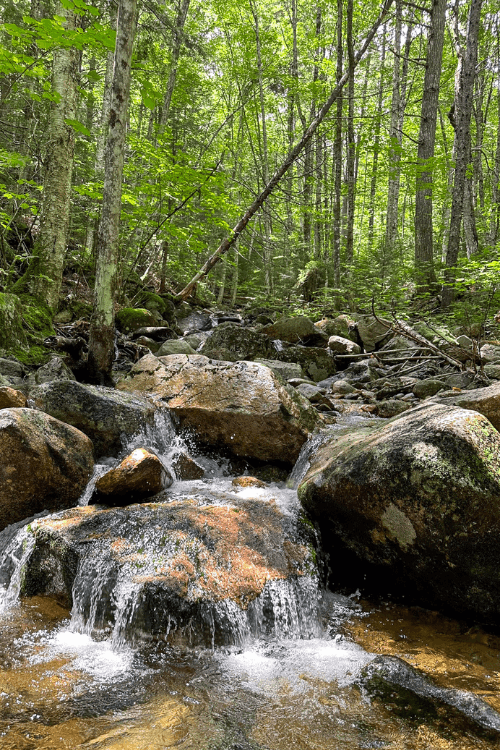
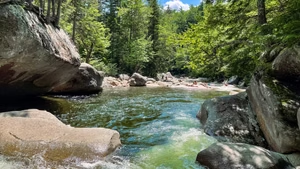
- Climb steadily for about 1.5 miles, passing small waterfalls and the Centennial Pool
- Hit the East Coast-style switchback that signals you’re close
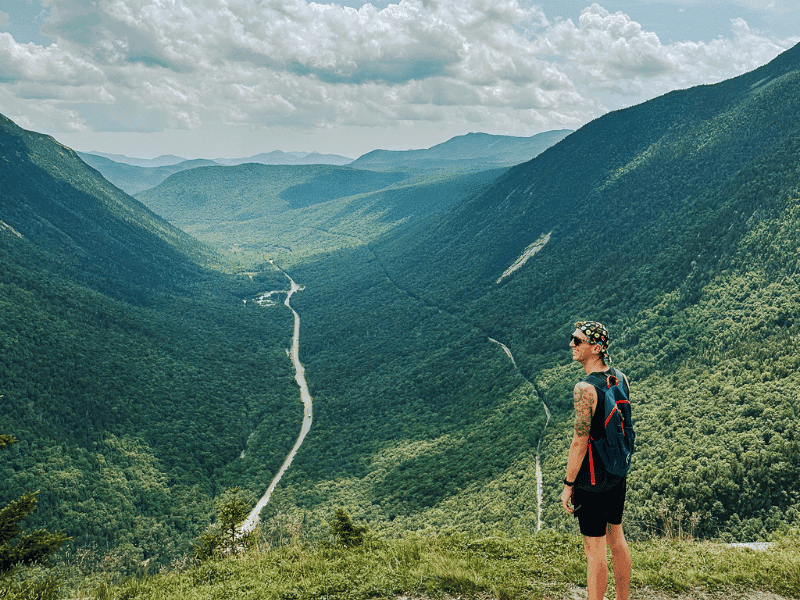
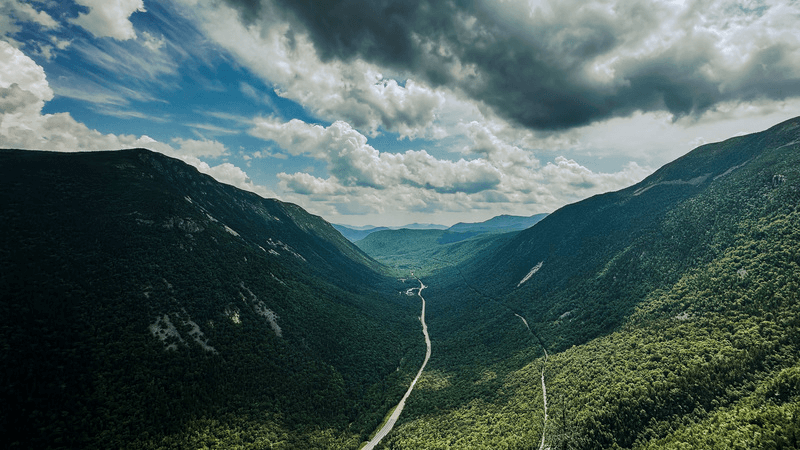
- Pop out onto the summit viewpoint over Crawford Notch
- Descend the same trail back to the depot
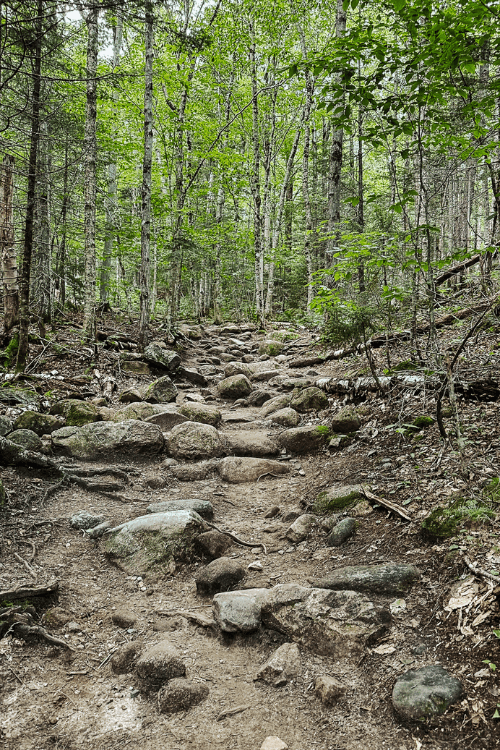
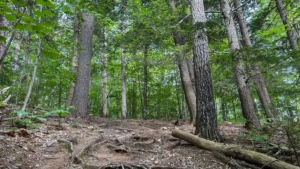
The climb: After the early fork, the trail heads into the thick of the forest and starts its real climb, holding that grade for about a mile and a half past the waterfalls and Centennial Pool. This is where the trail’s defining feature shows up: large, technical rocks that demand real foot placement, mile after mile. We hiked almost all of it; only a few short stretches were actually runnable.
- Liked: the technical footwork is genuinely fun if that’s your thing
- Frustrated by: this section eats time, so budget hiking pace, not running pace
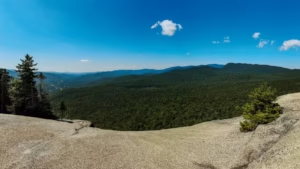
The summit push and descent: The trail stays fully enclosed by trees until the very last second, then opens onto the viewpoint with almost no warning. Depending on timing, the summit swings between packed and completely empty. I’ve had both. Heading back down, you can run more of it than you could climb, but the same roots and rocks that made the ascent technical make the descent borderline dangerous when wet.
- Liked: the reveal at the top is one of the better ones I’ve hit on the East Coast
- Watch for: always yield to uphill hikers/runners on the way down, it’s basic trail etiquette
Photos from the Mount Willard Trail

Mount Willard Trail logistics
- Budget 1 to 1.5 hours round trip, most of it at hiking pace on the way up.
- Bring more water than you think. There’s no water access on trail beyond the small stream crossings early on
- Take the rocky sections slow, especially descending. Wet roots and rocks here get genuinely dangerous.
- Go early, especially in fall. The lot at Crawford Depot fills fast and there’s no overflow to speak of.
- Check current WMNF signage before you go. Parking was free when I ran it, but forest fee policy has shifted at other trailheads in recent years.
Nearby trails
- Presidential Traverse (19 miles)
- Mount Moosilauke (7.5 miles)
- Franconia Ridge Loop (8 miles)
- Artists Bluff Trail (1.3 miles)
- Franconia Falls Trail (7.7 miles)
- Mount Pemigewasset (3.1 miles)
- Kearsarge North (6 miles)
Mount Willard FAQs
How long does it take to run Mount Willard?
Is Mount Willard hard to run?
Do you need a permit to park at the Mount Willard trailhead?
Can you run the whole Mount Willard Trail?

Plan your next runcation without overthinking it
A free, runner-tested weekend kit with:
- A simple trip-planning framework
- A packing checklist that actually works
- A quick decision guide for short travel runs

Leave a Reply