

Hill running is one of the most efficient things you can add to your training. But it’s also one of the most avoided.
Adding a hills to your training, though, can have huge benefits for your running as a whole, not just when you’re getting vert.
So, in this post, I’ll show you how to stop dreading the climb and how to start using it to your advantage.
Techniques to Run Uphill Faster
Look, I get it.
No one enjoys running uphill at the start. I didn’t, either. But as I added them to my training more, I realized I actually LOVED hills. They came to be a huge strength of mine. But that didn’t come without learning the basics first.
So, here’s a quick overview of the mechanics for better uphill running:
1. Body posture
Body posture is huge when you run uphill.
Your body should lean forward slightly. But don’t lean at the hips, instead focus on leaning at your ankles. This keeps your core engaged and your center…well, center! These slight adjustments keep you upright and also avoid straining your lower back.
Think of your body as a straight line from your head to your feet, just with a slight forward tilt.
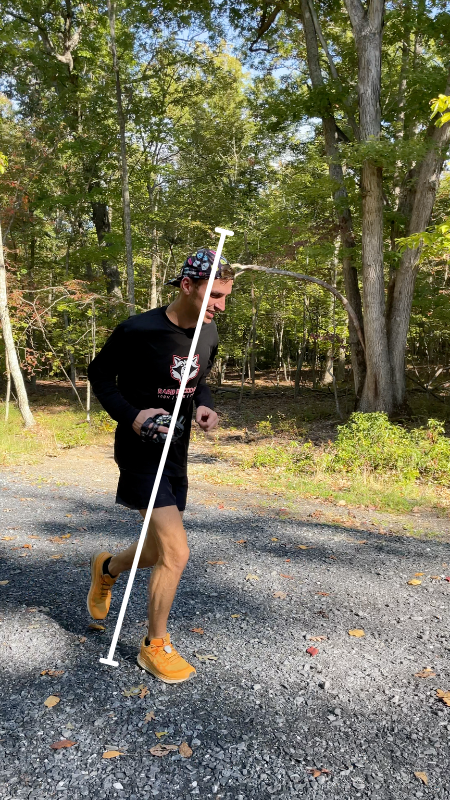
Don’t lean too much that you feel like you’re falling over. And make sure to keep your back upright to help with your breathing and to avoid overstraining muscles. It will feel awkward at first. But the more you do it, the more natural it will feel. (And the faster you’ll get!)
2. Arm movement
Your arms may seem useless in running (that’s why runners often look like they’ve never lifted a weight).
But your arms are extremely useful for running, especially on uphills. Your arms help drive your body forward, acting like pendulums. This momentum and rhythm assists the rest of your body in driving yourself uphill.
Keep your arms bent at a 90-degree angle and swing them forward and back. Not cross-body, and not out wide. Think of keeping them in a line by your body as they pump forward and back. It should also match the rhythm of your legs to maximize efficiency. As your left leg goes forward, your right arm pumps forward. And the same for your right leg and left arm.
Work on this on your flat running as well to help get the motion down.

Stay strong, wherever you run.
- 12 weeks of runner-specific strength
- Hotel & Airbnb-friendly sessions
- Build strength without losing run fitness
3. Stride length
Short strides make it an easy ride.
There are two methods when running uphill — long, powerful strides or short, quick steps. Longer, more powerful strides are great for using more of your muscles. Your glutes, quads, and calves all get a workout here, and it can help propel you up the hill faster. However, you risk burning yourself out extremely quickly. Shorter strides use more of your aerobic system, and can keep you going for longer. Hence why short, snappy strides are better.

Imagine you’re running up an escalator with tiny steps. The escalator is moving semi-rapidly, and the steps are only long enough to fit some of your foot on it. This will help you work on the stride pattern so it feels more natural.
This also reduces the risk of overstriding, which is one of the biggest injury causes for runners. Your legs land under your center of gravity, exactly where they should.
4. Maintain a steady pace
It’s tempting to just attack a hill right off the bat, right?
Whether to get it over with or to maximize the workout gains, sprinting up it just seems like a great option sometimes. But you should hold off on that idea.
Instead, keep your stride frequency and take it to the hill. You’ll absolutely slow down, and that’s okay! You’re running up a hill after all. But try to maintain a similar stride cadence. This reduces the amount of energy you lose adjusting your stride to account for the hill (more on this in the next section). And it also helps you save energy by keeping a consistent pace up the hill instead of charging up it full force.
Trust me, you’ll be thankful for the energy you save in the long run (pun intended).
5. Know when to walk
Here’s something many runners get wrong: walking uphill isn’t giving up. In many cases, it’s actually the smarter move.
At steeper gradients (around 8-10% or more) power hiking becomes more energy-efficient than running. You cover nearly the same ground for way less effort. Elite ultrarunners like Kilian Jornet don’t blast it up every hill. They also hike aggressively to save their legs for terrain where running actually pays off. I can vouch for this as I took this example into my Rothrock by UTMB 50K and aggressively hiked the climbs. It absolutely saved my legs for later in the race.
A simple rule to help guide you: if your heart rate is maxing out while running a steep section, try hiking it with purpose. If your effort level stays the same, you’ve found your threshold.
Two cues to keep an eye on:
- Effort: If you’re gasping to run up a grade, then you should be walking it.
- Distance: The longer you run, the more you should use walking intentionally. Blowing up on mile 3 of a 30-mile day isn’t difficult to avoid if you’re smart about it.
The key is that hiking uphill is just as much a skill that needs to be trained as everything else. Drive your arms, push off your knees, and keep your stride going. A purposeful hike beats a desperate shuffle uphill every single time.

Plan your next runcation without overthinking it
A free, runner-tested weekend kit with:
- A simple trip-planning framework
- A packing checklist that actually works
- A quick decision guide for short travel runs
Building Uphill Running Strength and Endurance
Running uphill obviously demands a lot from your body.
Your entire leg, lungs, heart, and also your mind get a workout when running uphill, especially compared to flat running. So, to get better requires some practice (and a lot of effort). Here are some ways to get started:
- Hill repeats: Hill repeats are EXCELLENT for building strength and improving as an uphill runner. It involves running uphill at a high intensity, then jogging or walking back down to recover. Then, repeat the process. There’s almost no better way to get better at running hills than just force feeding yourself them over and over again.
- Interval training: Intervals are similar to hill repeats in that it involves a high-intensity run for a short period, and it’s repeated X number of times. The only difference is these are done on flatter terrain. While these don’t help with hills as much as hill repeats, they target speed, endurance, and mental endurance.
- Strength training: Something most runners skip. But strength training for runners is an essential part of getting stronger and avoiding injury, depending how often you lift. Core especially is an overlooked part of uphill and downhill running. I refer to your core as Jenga blocks.
Below, you can find a few hill workouts from David Roche (an excellent coach) and Trail Runner Magazine. I’ve broken these down into beginner, intermediate, and advanced.
Beginner Uphill Running Workout

- Warm up for 10-15 minutes to prepare your muscles and ready for your workout.
- Find a hill with a decent incline.
- Run up the hill for 30 seconds at a moderate pace. Focus on form more than anything. Keep your eyes looking straight ahead, pump your arms back and forth, short steps with a consistent effort, and drive your knees up.
- Once the 30 seconds are over, walk down the hill for recovery. Take your time with this to allow yourself to recover correctly, about 60-90 seconds.
- Repeat 4-5 times, or as long as you can while keeping proper form.
- Work in a cool down to give your body time to come out of your workout.
Intermediate workouts
The Shark Teeth

This is a challenging workout, but not too difficult that you want to avoid the workout altogether. The 2-minute recovery will help you recover and prepare for the next round.
- 8x 1-minute steep hills
- Moderately hard on the uphill, 2 minutes of easy recovery walking down
Nice Legs Finish Blasted

This one asks a bit more of your leg muscles and will have you spent by the end. But that’s a good thing! You get massive rewards and will be eating hills for breakfast in no time.
- 4x 2-minute hills moderately hard, run down for recovery
- 4x 1-minute hills hard on the uphill, run down for recovery
- 4x 30-second steep hills as hard as you can
Advanced Uphill Running Workout
The Hill Beast

This one is tough. And, yes, that’s an understatement. In all reality, this one will take a bit of your soul with it and leave it on the hills. But, any mountain you encounter after this will be a piece of cake.
- 10/8/6/4/2 minute hills moderately hard, run down for recovery in between
Mental Strategies for Uphill Running
I’ll be flat out. Uphill running is just as much mental as it is physical.
And learning how to keep your mind focused and motivated will make a HUGE difference in all aspects of running. Here are some strategies to help your mind:
- Set small goals: Breaking the hill into smaller segments makes the climb seem less…gigantic. Instead of focusing on the entire hill, divide it into small sections. Whether its landmarks or just a certain distance. This will help you stay on task and from getting overwhelmed.
- Positive self-talk: I’m not a person who’s into new age-y, pure positivity style stuff. But there’s absolutely something to how you’re talking to yourself during something difficult. Beat yourself down, and you’re bound to give up. But reminding yourself you can do it and giving your self little boosts mid-way help keep you going.
- Focus on form: Honestly, sometimes you just need a distraction. And focusing on keeping good form is one easy distraction, especially because there’s probably some aspect you can fix. Remind yourself of the things we talked about above — posture, arm movement, cadence, and stride length. Before you know it, you’ll be at the top!
Ultimately, test out different things. Maybe you need to pop headphones in for the climbs to get some motivation. Maybe it’s having a partner with you to push you up. Whatever it is, test it out and find what works for you.
Ready to Run Uphill Faster?
Hills will always be hard. And that’s the point.
Runners who figure that out early show up on race day with something left when everyone else is dying on the climbs. I’ve always enjoyed climbs to some extent. But once I learned how to run them properly, it changed everything. But it didn’t happen overnight, just one repeat at a time.
So, now it’s your turn. Good luck out there.

Leave a Reply