

If you ask 10 runners how often you should strength train, you’d get 12 different answers somehow.
Some swear by daily gym sessions, others avoid anything heavier than a coffee mug (this is most runners).
I used to be in the “skip strength and run instead” camp. I figured it would just make me sore and slow me down. And that’s time I could spend running anyways. Isn’t that what I’m trying to get better at? Turns out, I was skipping one of the biggest performance boosters a runner can have. And I learned the hard way, through injuries, burnout, and races where my legs gave up before my lungs did.
So, in this post, we’ll cut through the noise.
I’ll explore how often runners really need to strength train, why strength training for runners matters, and how to make it fit into your life without overcomplicating things. And I’ll include expert opinions along the way.
Let’s get started.
For most runners, 2–3 strength training sessions per week is the sweet spot. That’s enough to build and maintain strength without wrecking your legs for key runs. If you’re new to strength training, start with 1–2 sessions per week. You can always build up as your body adapts.
Table of Contents
How Often Should Runners Strength Train?
If you want the quick answer: Most runners benefit from 2-3 strength training sessions per week. That’s enough to build and maintain strength without leaving your legs trashed for key runs.
“I’m a strong believer that strength training should be done a minimum of 2-3x/week.“
— Jim Cash, Certified Strength Coach and Owner of Built Training Facility in Columbus, Ohio
But, “optimal” isn’t the same for everyone. And it can depend on a few factors, like experience level, running volume, and your goals.
A good starting point is:
- Beginner runner: 1-2 sessions/week
- Intermediate runner: 2-3 sessions/week
- Advanced runner: 3 sessions/week in off-season, 1-2 sessions/week when racing

Stay strong, wherever you run.
- 12 weeks of runner-specific strength
- Hotel & Airbnb-friendly sessions
- Build strength without losing run fitness
When to Strength Train in a Standard Running Week
One of the most common questions runners have (I know I did) isn’t only how often, but when.
When you’re balancing easy runs, hard workouts, and long runs — it’s hard to know where to fit it in and actually be effective (and not exhausted).
The simplest rule: Put your strength work on your hard run days as much as possible. That way you get to actually rest on your easy/rest days (which is necessary for running after a hard leg day).
That way:
- You keep your hard days hard and easy days easy
- Your easy/recovery days are focused on restoration
- You avoid carrying fatigue into another session
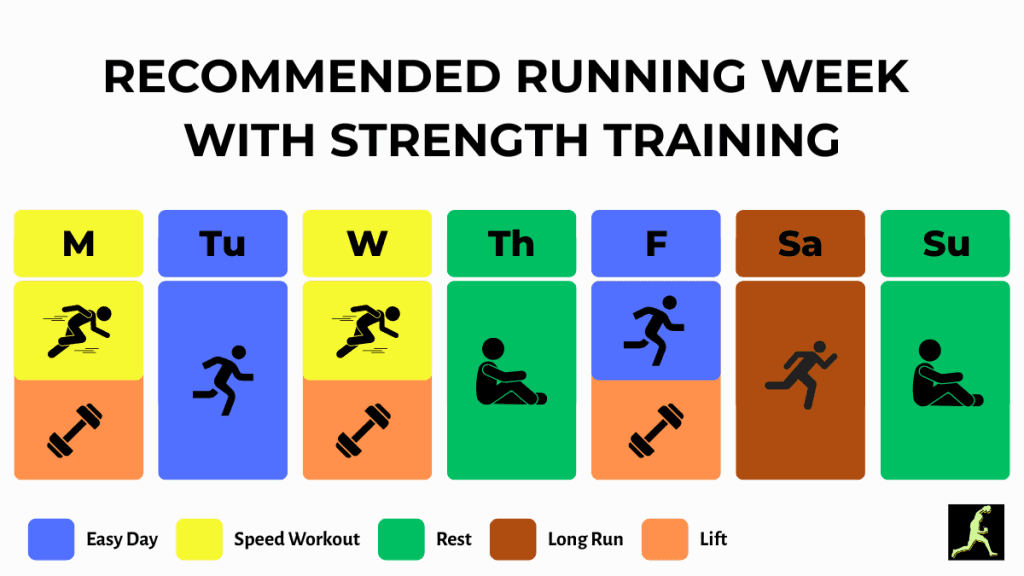
At the end of the day, the “right” schedule is the one you can stick to consistently.
Remember, strength training isn’t about replacing your runs. It’s about supporting them to help you run faster, farther, and with fewer injuries. Build it into your week, make it routine, and your future self on race day will thank you.
Should You Run or Lift First?
The thought of having a lift and speed workout in the same day is daunting. Possibly even worse? The idea of doing one after doing the other. So, it asks the question, which should you do first?
The general rule: Do your most important session first.
If your priority is running, run first. If you’re in the offseason and focused on building strength, lift first. Simple as that.

For most runners, that means:
- During race training: Run first to hit the paces, effort, and form without fatigue from lifting.
- During strength phases: Lift when your legs are fresh to get the most from the heavier, technical lifts.
It may not seem important, but fatigue changes how you move.
And that fatigue can increase your injury risk depending on your activity. So, prioritize your focus first, then do the other after.
Personally, I almost always run first since it’s my main goal. But, if it’s an easy run paired with a heavy lift, I don’t worry about the order too much. I just focus on keeping the run truly easy so I have what I need for the lift.
Bottom line: Decide what matters most to YOU and do that first. Just make sure the second session doesn’t turn into a junk workout.
Why Runners Need Strength Training
When I first started running, I thought strength training was optional.
Nice-to-have, sure, but not essential. After all, I just wanted to run more, not spend extra time in a gym.
Then the little things started creeping in — sore knees after long runs, tight hips that made every uphill feel like a grind, and an ankle that would roll if I looked at a rock the wrong way. That’s when I realized: running doesn’t just build fitness, it exposes weaknesses. And strength training is how you fix them.
“A lot of people believe that it should be an either/or approach, but I feel that it can be done in conjunction with running and should complement each other. Proper resistance training should make running easier, not more challenging!“
— Jim Cash, Certified Strength Coach and Owner of Built Training Facility in Columbus, Ohio
Here’s why it matters so much:
Injury Prevention
Running is super repetitive. Step after step, mile after mile, you’re hitting the same muscles, tendons, and joints. Strength training builds resilience so those tissues can handle the impact without breaking down. (Many people turn to stretching and running here, but strength work is a better option.)
- Stronger muscles absorb more force, taking pressure off your joints.
- Balanced strength reduces overuse injuries (hello, IT band and shin splints).
- Stability work helps keep your form solid when fatigue sets in.
Better Performance
You don’t just get stronger in the gym — you get faster on the trails, too.
- Power translates to better climbing and stronger finishes.
- Core and hip strength improve running economy (less wasted energy).
- Sprinting up a hill feels less like punishment and more like a challenge you can win.
Longevity
I want to be running trails decades from now, not talking about how I “used to run before my knees gave out.” And strength training is like an insurance policy.
- Reduces breakdown over years of running.
- Helps maintain muscle mass as you age.
- Keeps you moving well — on the trails, in races, and in everyday life.
Bottom line: strength training isn’t just cross-training “extra credit.” It’s the foundation that helps you run longer, faster, and with fewer injuries. And, if you’re serious about running, it’s worth making space for in your week.
Free 1-Page PDF
Get These Workouts on the Go
- Single page you can save to phone for fast workouts.
- Simple tips to progress across 4 weeks.
A Simple Starting Point for Strength Training
If strength work feels like one more thing to cram into your already overloaded week — start small.

Just like when you began running, you don’t need a perfect plan. You just need to start. Here’s a beginner-friendly setup you can try this week:
- Two sessions per week on your hard run days (for example, speed workouts or hill days)
- 20-30 minutes each
- Full-body focus — think squats, lunges, hip bridges, planks, push-ups (this is all just to get you started)
- Keep the weights light-to-moderate at first; focus on form
Once that feels like a regular part of your routine, you can add a third day or start increasing the intensity.
If that feels like something out of your repertoire and you want a ready-to-use plan built for runners, I created The Travel Runner Resistance Plan with my cousin, Jim Cash, a pro strength coach. It’s designed to fit around your runs, build running-specific strength, and help guide you along.
Strength Training That Supports Your Running
You don’t need to live in the gym to get faster, stronger, and stay injury-free. Just make strength work a regular part of your week.
For most runners, 2–3 sessions on hard run days is the sweet spot. Do the most important thing first — run before lifting during race training, lift first in the off-season — and you’ll see the payoff in your runs, your recovery, and your long-term health.
Start small, keep it consistent, and let it build. Over time, those short sessions stack up to more powerful strides, fewer injuries, and better runs.
![Strength Training for Runners [Faster & Injury-Free]](https://www.thetravelrunner.com/wp-content/uploads/2025/08/db-bench-press-strength-training-300x169.png)



Leave a Reply